People calculate too much and think too little. That’s an insight from the late, great investor Charlie Munger that applies as much to paid search marketing as it does to finance. Because here’s a dirty little secret about many paid search teams: They often get bogged down in tactics — calculating whether to invest in traditional search or PMAX or Demand Gen — rather than zooming out and discussing how they’re going to make all the channels weave together.
By failing to leverage tools that maximize their clients’ budgets, paid search teams can work in ways that feel siloed and myopic. Our advice for all the brands out there? Make sure you’re asking your paid search team these questions:
- What overarching strategy is your paid search team bringing to the table?
- Are they showing you how they can handle the modern user journey with search platforms that all connect and complement one another?
Why Is This Important?
Google uses the term “the 4S behaviors” to describe the user journey, which stands for “Stream, Scroll, Search, Shop.” Think of those stages like this:
- Stream: You’re watching a show on Hulu and an ad appears for Nike.
- Scroll: You pick up your phone and poke around on Nike’s website.
- Search: You really like a pair of shoes, so you do your research on it.
- Shop: You’ve gotta have the shoes, and a few clicks later, they’ll be arriving tomorrow.
All those steps show that the user journey is more complicated than ever, so paid search teams have to make sure we’re ready to meet the user at the right time with the right message. That message might not always be “Buy from us right now,” because if we don’t meet the user with the right message in the right medium at the right time, we may accidentally push them toward our competitors without realizing it.
7 Questions To Ask To Get Started On Your Paid Search Strategy
Developing a paid search strategy takes time, energy, effort, and a coordinated team to make sure it’s complete. We want this discussion of paid search to inspire you to develop your own paid search strategy. You can also reach out to the paid search team at Mindgruve for an evaluation of your current search strategy. Either way, we recommend always asking the following questions:
- Will this channel reach prospective clients more cost-effectively than other tactics?
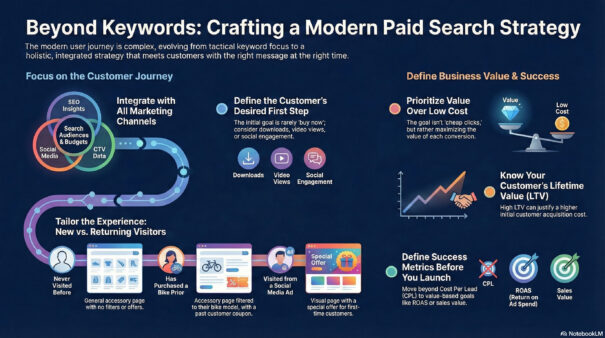
- Am I leveraging other channels (SEO, CTV, display, social media) into our search work?
- What is the first step that I want this customer to take?
- Do I know if this prospect is a current client or new to our brand?
- What is the client worth to us today?
- What is the lifetime value of the client?
- How are we measuring the success of this strategy?
While it might seem strange to search folks who have been in the business for a long time, not a single one of those questions is: “Which keywords should we bid on?” That’s because it’s more important to prioritize a bird’s-eye strategy at the outset rather than getting tangled up in the tactics of keyword bidding. Let’s dig deeper into each of those questions.
Question 1: Will this channel reach prospective clients more cost-effectively than other tactics?
Let’s get this out of the way: Paid search teams are seeking value — not the lowest cost. Our goal is to maximize value rather than focus on easy clicks. First, look at your target market. Then ask yourself:
- Is the geographical area of the prospective targets large or small?
- Do we have benchmarks of other clients that have targeted this type of market before? That might include CPL (cost per lead), CPA (cost per acquisition), CPC (cost per click), and CTRs (click-through rates).
- How often do we need to reach this user to get them to make a purchase?
As you start to answer questions like this about your market, you may discover that certain tactics are more cost-effective than anything paid search can offer. If you can advertise on a channel that can route a user to your store or website for $0.10 per click, and search costs $1.60 per click, then your search strategy is 16x more expensive than the alternative. At first glance, that investment may seem like a no-brainer. But don’t rule out paid search even in that situation, because the quality of the visit that it generates may still lead to sales. Nonetheless, the difference in price will inform your paid search strategy and your overall media mix.
Question 2: Am I leveraging other channels (SEO, CTV, display, social media) into our search work?
This is one of the issues you should address upfront because it helps bring together all of your efforts and visualize the entire project in one place. As an example of how to leverage work for other channels, let’s head over to the SEO department.
Your SEO team might be crushing it in a variety of search metrics, so pop open the hood of Google Ads and check out the paid and organic reports. Partner with your analytics team to determine incrementality of search for particular phrases. Structuring your tests to see the true impact of search can help you find out if you need to bid on certain keywords. That process allows you to use your budget on other paid search terms where the organic results aren’t performing as well.
After you coordinate keyword insights with SEO, check in with your social, display, and CTV teams to take a more audience-based approach. At Mindgruve, this step allows us to maximize a client’s media dollars all the way from awareness to purchase. If our CTV team is making an awareness push for users who are in-market for a vehicle, then our search team makes sure to find the corresponding audience within the search platform to capture those users. We also leverage platforms like DV360 and SA360 that help us manage this audience flow and boost media performance.
So how do you know if the agency (or agencies) handling your paid search tactics is doing this type of cross-channel work? Ask them:
- How often do your teams talk to each other?
- Can I see how my media is performing across audience groups?
- How did you select the audiences?
- How do we make sure that we aren’t missing out on audiences that might be looking for our product or service?
- Are there keywords where we’re paying for clicks that we’d get for free, anyway?
Question 3: What is the first step that I want this customer to take?
In a perfect world, the first step that a customer takes would be to buy from you and then become your biggest, loyal raving fan ever, constantly raving about you in online reviews. That would be the ultimate first step. In case that doesn’t happen, however, paid search teams should figure out what first step the customer can take that will add value to the business.
A traditional search standpoint can sometimes become too focused on customers filling out lead forms or scrolling through product detail pages. True, those steps can be valuable, but it’s also important to look at other touchpoints that a customer might have had with a brand and ask how those touchpoints might affect the customer’s first interaction with paid search messaging. Here are a few of those touchpoints:
- They’re active on your social media.
- They watched a YouTube video you made.
- They downloaded a white paper you published.
- They’re on your email list to get a free course or a coupon.
Question 4: Do you know if this prospect is a current client or new to our brand?
The more you know about a prospect, the better chance your search team will be able to guide them toward a part of your website where you want them to go. That means your search team should be connected with your other channels to maximize their knowledge about each website visitor. Remember, it’s all about the right message in the right medium at the right time.
Let’s look at a few ways that a user could arrive at your website from a paid search perspective. Imagine that we’re marketing bicycles — which we’ve done for our clients before — and that this prospective client searches the phrase “ebike accessories.” Here are a few potential scenarios:
- This client has never visited your website.
- This client has already purchased a bike from you.
- This client has come to your website in the past from an ad on social media.
Many search teams don’t look at audience-level details such as where a client lives, so they might send this prospective client to the same accessory page in each scenario. But a paid search team that works carefully might send the user to a different webpage depending on each scenario that we listed above:
| Prospect Stage | Potential Landing Page(s) |
| Never visited the website before. | Direct the user to the accessory page with no filters and no initial offer. |
| Already purchased from you. | The accessory page with a filter for their bike model.
A page with a special coupon for past customers. |
| Visited your social media in the past. | A visual page with an offer for first-time customers. |
You might not be able to direct users to different pages because of website limitations or because of the size of your audience. (If only a few people search for a keyword, you won’t have reliable data to know how to segment them across your site.) That means you should design the user experience to account for more than just the search phrase they typed in.
Question 5: What is the client worth to us today?
Another way to pose that question: “What am I willing to pay to acquire a new customer?” Smart companies are often willing to lose money or break even on a customer initially because of their long-term value. We see this mentality in action with our financial clients. Each financial institution assigns a different value for what they think a checking account is worth. Even though the numbers differ from client to client, the thinking might work out like this:
- The financial institution determines that a checking account is worth $400.
- They’re willing to pay $450 to acquire a new client.
- At the initial transaction, they’re willing to accept a loss of –$50 because they know the new client will be worth far more than $50 over the course of their lifetime value.
Deciding how much a customer is worth to you today, as well as what you’re willing to pay to acquire that customer’s business, must be part of your search strategy. That decision allows your search team to set up appropriate guardrails in the account — such as CPL targets, ROAS targets, or maximum CPC that meet the needs of your business today and far into the future.
Question 6: What is the lifetime value of the client?
The more valuable a customer becomes to your business over time, the more it makes sense to spend to win them over in the first place. One time, we had a client who sold a powder that you mixed with water to make an energy drink. When customers tried the drink, they often turned into repeat buyers. Their lifetime value analysis showed us that folks would buy the product for years, which helped us justify an additional margin to spend acquiring new customers in an extremely competitive space. That’s why we recommend combing through your customer database, looking at all the products and services that each customer buys from your company, and determining the lifetime value of each customer.
Question 7: How are we measuring the success of this strategy?
Even though agencies generally tap into paid search strategies toward the bottom of the funnel, setting up the criteria for success well before that stage is key. You want to decide on your KPIs and establish which metrics you’re tracking:
- POAS across a particular product line
Defining what success means in a campaign before you launch it will help you avoid challenges down the road when you’re trying to determine if the overall campaign hit its goals.
Why do we bring this up?
In the past, we’ve seen clients define success as achieving a certain cost per lead target. While a target CPL is a worthwhile initial target, a better goal might be “value per conversion” or “sales value from leads.” You’re not trying to generate high-cost leads. Instead, you’re after the most valuable leads — not the leads that cost the least.
Develop A Complete Search Strategy For Your Business
“A great business at a fair price is superior to a fair business at a great price.” That’s another insight from Charlie Munger, and we take it to heart when we’re handling client budgets. Today’s user journey is more complicated than ever. Fortunately, the goal of paid search remains the same: Finding your best type of customer who will remain loyal to your business over the long term. Because locating high-value leads at the right price will lead to far greater results than simply chasing cheap clicks. So talk to your internal team, your agency, or contact us to develop a complete search strategy that fits your company’s goals.
Want to ask a question or learn more? Get in touch with us today.