Sixty percent of automotive aftermarket businesses expect demand to grow in 2026. The catalyst has nothing to do with a breakthrough product or a clever brand campaign. Sticker prices on new cars are doing the work.
Today’s economy and new vehicle costs have pushed American consumers to hold onto what they already own, and that behavioral shift has quietly rerouted hundreds of billions of dollars in repair and maintenance spend toward a channel most OEMs still treat as an afterthought: the independent aftermarket. Fifty-seven percent of consumers globally now prefer to buy replacement parts from independent aftermarket sources over original equipment dealers. These aren’t bargain hunters settling for less. They’re informed buyers making deliberate choices, and they’re increasingly loyal to whoever earns their trust once the factory warranty expires.
The aftermarket power shift has nothing to do with supply chains. Brands are failing to capture demand that’s already there. The brands and channels that win the next decade will be those that treat the out-of-warranty window as a first-class marketing and retention problem, not a parts-logistics problem.
The $434 billion opportunity hiding in plain sight
The scale here demands attention. The U.S. automotive aftermarket alone is expected to reach $434.9 billion in 2025, growing 5.1%, with the broader light, medium, and heavy-duty segment projected to hit $664.3 billion by 2028. The category isn’t shrinking. Differentiation within it is.
Globally, McKinsey and CLEPA project the aftermarket to grow at roughly 3% annually through 2030, with China emerging as the primary engine at 8.1% CAGR while Europe and North America contribute a more modest ~1.5%. But the composition of that growth matters more than the rate. Spend is migrating toward independent workshops, digital-first purchasing, and markets where OEM brand loyalty barely registers. For automakers, this means ceding lifetime customer value at the precise moment repair frequency and parts spend accelerate. For independent distributors, it means the window is wide open, but only for those investing in digital discovery and trust infrastructure, not just shelf depth.
The average American vehicle is now 12.8 years old. That number reflects where the commercial relationship actually lives, not a story about deferred purchases. And for most vehicles on the road today, no brand is actively competing for that relationship.
Economics is doing the marketing’s job
The consumer migration to independent channels isn’t born from dissatisfaction with OEM quality. It’s driven by arithmetic. When a dealership’s brake job costs 40% more than the independent shop two miles away, and the consumer can verify that spread in seconds on a phone, the math wins.
McKinsey’s aftermarket research confirms the pattern: as vehicles age past warranty, the share of spend shifting to independent workshops and parts channels accelerates nonlinearly. The 57% global preference for independent parts tracks directly with rising transaction prices and lengthening ownership cycles.
The marketing implication is sharp. The warranty-expiration moment is the highest-leverage conversion point in the ownership lifecycle. It’s where a customer transitions from captive to contestable. Almost no one, OEM or independent, treats this inflection with the same rigor applied to new-vehicle acquisition. That’s a gap worth billions.
Digital discovery is the new distribution advantage
Parts distribution used to be a logistics moat. Whoever had the right SKU on the right shelf in the right metro won. That moat has eroded.
McKinsey projected online B2C sales of automotive parts and accessories to capture a growing share of the overall aftermarket, with digital platforms collapsing the information asymmetry that once kept customers tethered to dealership service departments. China’s aftermarket, growing at roughly 8% CAGR versus ~4% for new-car sales, already operates through a network of more than 340,000 distributors and 460,000 repair shops, increasingly connected by digital platforms.
The parallel to broader automotive digital marketing is exact. High-intent shoppers leak between platforms, pages, and stores. In the aftermarket, a consumer searching for a catalytic converter lands on three sites and buys from whichever one delivers the clearest availability, price, and trust signal. Inventory feed logic, local search presence, fitment specs, visibility in LLMs, and review infrastructure matter here as much as they do in new-vehicle VDP (Vehicle Detail Page) strategy.
The connected-car counterargument
Smart skeptics will point to OEM advantages in connected-car data. They’re right to. 58% of consumers in the U.S., Germany, Brazil, and China said they would follow their car’s in-dash recommendation for where to service, according to McKinsey. That’s a powerful distribution channel baked into the dashboard.
But this advantage concentrates in newer, connected vehicles precisely the segment not driving current aftermarket growth. The volume opportunity sits in the aging, out-of-warranty, non-connected fleet where OEMs have the weakest presence, and independents have the strongest. McKinsey’s own analysis warned that OEMs need to secure “data and service sovereignty for connected services,” an implicit acknowledgment that the unconnected majority remains up for grabs.
The power shift is happening in the gap between where OEMs could compete and where they actually show up.
What aftermarket brands should do
Based on price, ease, and relationships, OEMs are currently positioned to continue to lose both market share and long-term consumer trust. To take advantage of these trends, here are three principles for aftermarket brands and the marketers who support them:
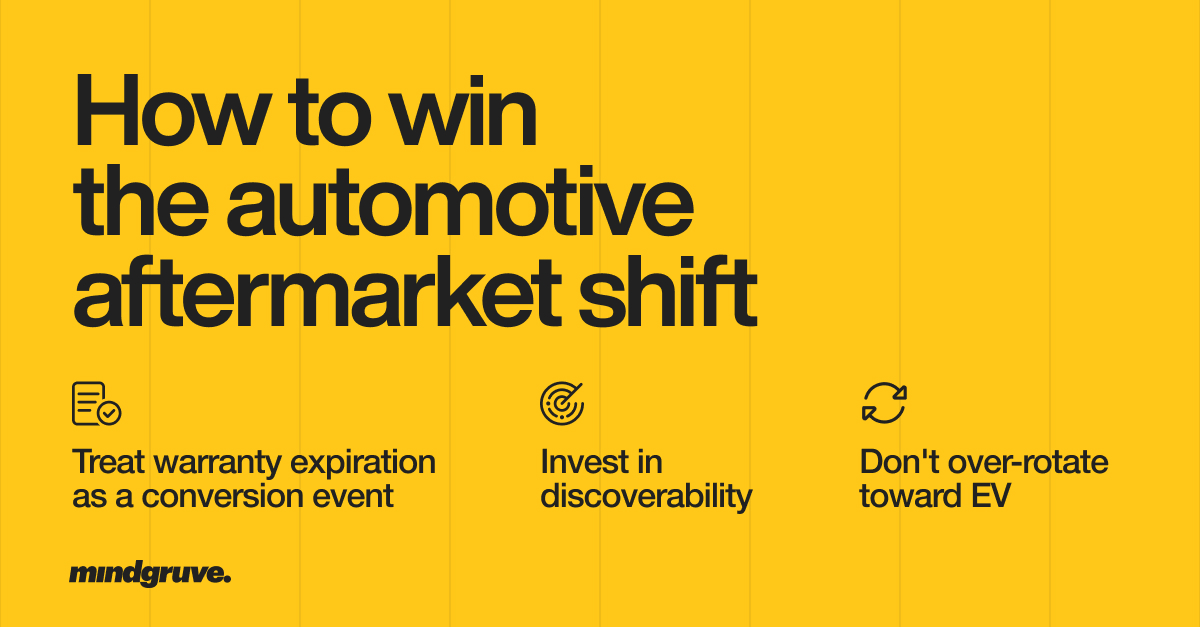
- Treat warranty expiration as a conversion event, not a customer loss. Build marketing triggers (email, search, local) around ownership age milestones. The same speed-to-lead logic that drives new-vehicle sales applies. Whoever reaches the consumer first with a relevant, trustworthy offer wins the next three years of maintenance spend.
- Invest in discoverability, not just inventory. Dynamic ad groups tied to parts availability, geo-targeted search campaigns, and review generation programs. These are the aftermarket equivalents of vehicle detail page optimization. The distributor with 50,000 SKUs but no local search presence loses to the one with 20,000 SKUs and a Google Business Profile that answers the consumer’s actual question.
- Don’t over-rotate toward EV readiness at the expense of the ICE fleet paying the bills today. Electrification will reshape the parts mix eventually. But the commercial opportunity for the next five to seven years sits overwhelmingly in the aging internal combustion fleet that dominates roads worldwide. A dual-track approach that captures current demand while building future capability beats a premature pivot.
The real competition
The aftermarket doesn’t fail because of product quality or supply-chain fragility. It fails at the moment of attention. A vehicle owner who just paid off a car, whose warranty lapsed eighteen months ago, and who noticed a dashboard light this morning, that person is going to search, compare, and decide within hours. The brand, distributor, or shop that meets them in that window with clarity, availability, and credibility captures a customer who may stay for a decade of maintenance.
Most automotive brands built their empires on sales. The next era belongs to whoever owns the maintenance.