Social media used to build awareness, chase follower counts, and push people toward a website. That job is gone. We called shoppable features a promising add-on when we published four social media best practices for retail brands in 2024. They run the whole channel now: discovery, decision, and purchase happen in the same scroll. Big shopping moments like Amazon Prime Days, back-to-school, and the holidays either prove that out or expose the brands that missed it. U.S. social commerce sales hit $87 billion in 2025 and will pass $100 billion in 2026, according to eMarketer.
This shift matters more for some retailers than others. Social commerce performs best for categories that are visual, lower in price, and short in consideration: apparel and accessories, beauty, food and beverage, and other impulse-friendly products people buy without a spreadsheet. Big-ticket, high-consideration purchases still depend on research and sales support. Social now operates as a primary storefront for brands in those impulse-friendly categories. It stopped being a top-of-funnel teaser the moment TikTok Shop hit the U.S. and took off in 2023.
Brands whose social channels still ignore commerce cues and tools should start shifting strategy now. None of this means turning your feed into a checkout terminal. Social works because people come for content that feels human. Commerce now runs alongside that content instead of replacing it. The job is to stay authentic and sell at the same time. Here are five ways to do both.
1. Treat the social feed as content and commerce at once
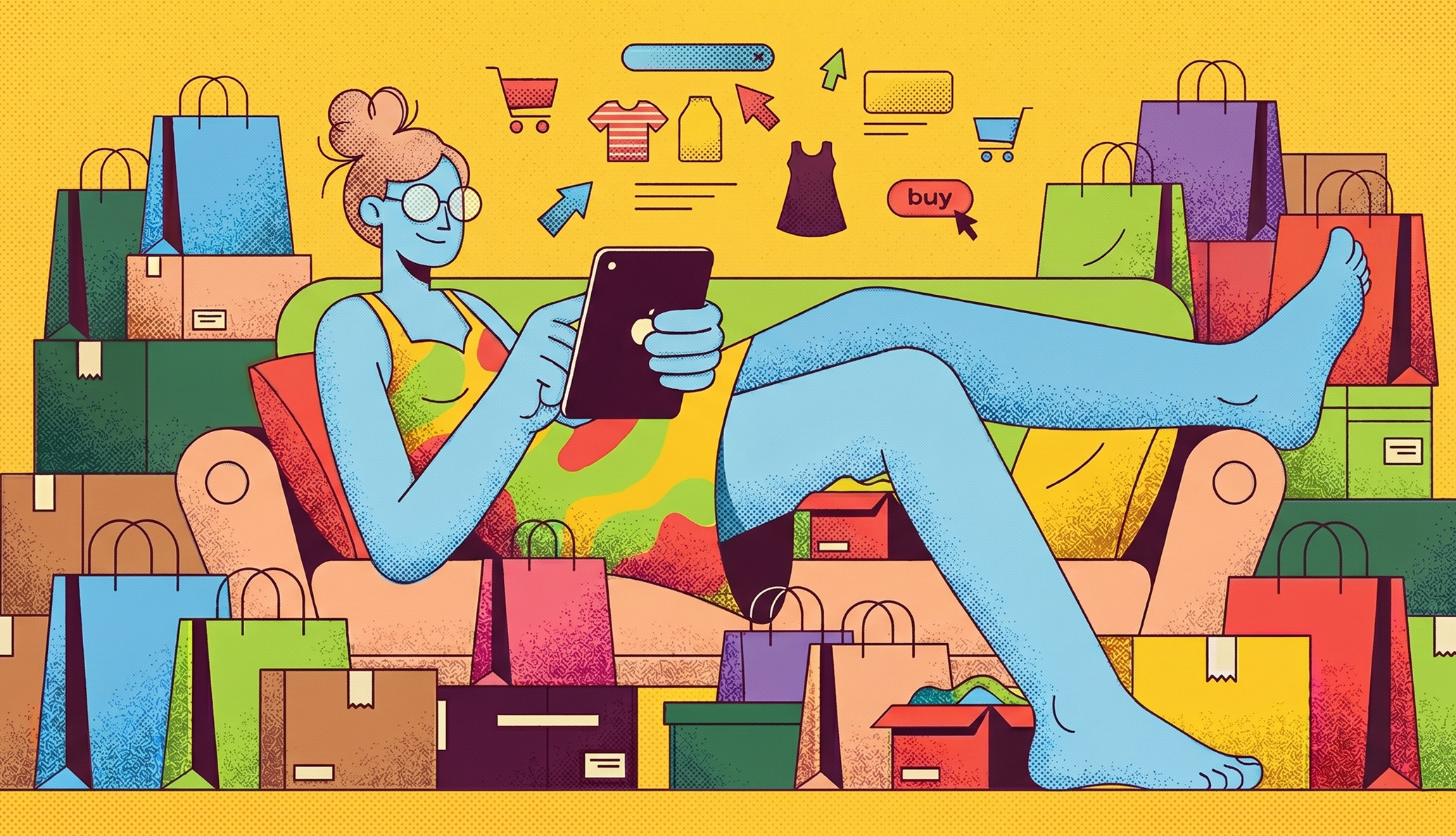
Nearly half of U.S. digital buyers, 47.5%, now make at least one purchase on social media each year. The line between browsing and buying has collapsed into a few taps inside a single app.
This doesn’t mean every post becomes a product listing. Reach and engagement still matter, because content that earns attention travels further into new audiences’ feeds. Give your audience the content they actually want, and the selling follows. What’s new: revenue now sits on the same scorecard as your engagement and awareness KPIs. The content that converts usually feels authentic and useful already, a customer trying on a jacket in her apartment, demonstrating a serum, or styling a corner of her home. Tagged and shoppable in-feed, it sells without looking like it’s selling. That UGC and UGC-style content outperforms a studio campaign because it reads as real. Build a system to source, license, tag, and redeploy customer content as shoppable assets, so the posts that feel native do the selling.
Measurement gets harder here. The funnel collapses into one screen, attribution turns messy, and teams drift back toward vanity metrics. Resist that. Connect social activity to add-to-cart, checkout, and assisted revenue with the same rigor you bring to paid search. Build measurement that ties organic and shoppable social to full-funnel revenue and moves past last-click ROAS, so the channel earns judgment on real impact.
2. Give TikTok Shop its own P&L
TikTok Shop graduated from test to channel. U.S. sales surged 108% in 2025 to $15.8 billion, a 22.8% share of U.S. social commerce, per eMarketer, and the platform stays on pace to clear $20 billion in 2026. Live selling compounds it: U.S. livestream shopping should reach roughly $68 billion in 2026, per Statista. The opportunity and the mechanics both differ enough to demand their own plan. The algorithm rewards native, unpolished formats, the unscripted review, the get-ready-with-me, the haul, and it ranks products by interest signal over follower count. A challenger apparel label can outsell a heritage brand on creative alone. Live selling raises the ceiling further. A weekly live try-on for a denim brand, hosted by a creator who answers fit questions in real time, closes sales a week of static posts never could, because it kills the last objection the moment a shopper feels it. Running TikTok Shop off your Instagram calendar dilutes both. Give TikTok its own creator roster, cadence, creative, and P&L. Staff it or partner for it. Don’t bolt it on.
3. Pay creators for outcomes
The creator economy evolved from reach to revenue. U.S. influencer marketing spend passed $10 billion in 2025 and should reach about $12.17 billion in 2026, according to eMarketer. Affiliate links, commission tools, and trackable storefronts tie a partnership directly to sales, which moves the conversation from cost per post to cost per acquisition.
Build your program in tiers. Use macro influencers for awareness and cultural relevance, point micro and nano creators at conversion, then measure the two against different goals. An apparel brand might anchor a campaign with one designer collaboration and fifty everyday creators filming try-on hauls that link straight to product pages. Creators who move units earn more budget or higher commission. Creators who only generate impressions get re-evaluated.
The strongest programs then put paid media behind the organic content that already proves out, running ads through the creator’s own handle so the spend borrows the creator’s credibility instead of a brand logo. Treat your creator roster like an investment portfolio. Invest in it to build real relationships, then rebalance every quarter toward the handles driving performance and pull budget from the ones that aren’t.
4. Win the social search box before the shopping rush
Social became the new product search bar. Nearly half of U.S. consumers, 49%, have used TikTok as a search engine, up from 41% two years earlier, according to Adobe. Gen Z pushes that to 65%. Younger shoppers increasingly start product discovery inside Instagram and TikTok rather than a browser.
That changes what optimization means. Captions, on-screen text, spoken keywords, and product names are your new metadata. Treat the first two seconds of a video and its caption the way you treat a title tag: seed the exact phrases shoppers type, tag products natively, and build evergreen answer content for the queries that repeat every season, sizing, fit, fabric, and styling. Shoppers search in-app for “fall capsule wardrobe,” “best products for oily skin,” or “portable speaker for hiking.” Miss the top queries your audience searches, and you go invisible at the exact moment of intent.
The same discipline now extends to AI answer engines, which read that structured language to decide what to show. Optimizing for social search and optimizing for AI discovery are converging into one job. Brands that build the muscle this year collect the benefit as the two merge and social feeds more of what AI shows.
5. Staff social like a commerce team, not a newsroom
The social media director at a retail brand now runs a commerce function. The community-and-content job description stopped matching reality a while ago. Social media ranks among the top channels consumers use to discover brands, and it skews highest among the under-25 shoppers apparel depends on, according to DataReportal. It’s also where many of them buy. Yet most brands still staff and measure social like a newsroom: posts shipped, impressions counted, sales handled by a different team down the hall.
That split is the bottleneck. The legacy model put content on one team and commerce on another, and those teams have to merge now. Your social team already learned to work with PR, customer service, and product marketing. Retail and commerce come next, and it’s where the revenue flowing through social gets captured or lost.
The organic social lead also holds the sharpest read on demand a brand has, watching what customers want and react to weeks before it shows up in sales data. That earns them a seat in the product and merchandising conversation, well beyond the campaign calendar.
The silos to break extend past your org chart. Social, marketplaces, and search are converging into a single path to purchase. The same customer might find your jacket through a creator’s TikTok affiliate link, an Instagram shop, and a marketplace storefront in one week, so the social team has to move in step with commerce, retail media, and merchandising rather than run a separate track. A post, a product page, and a marketplace listing now form one connected journey, and teams should read them end to end.
Two moves turn social from a cost center into a commerce function. First, change the scorecard. Reach and engagement stay, but the real KPIs become pipeline: saves, DM inquiries, product-page traffic attributable to organic posts, social-influenced conversion, and in-app conversions. Second, build the team’s knowledge. Social hires at a commerce brand now need a blend of creative instinct, community fluency, analytics, and basic merchandising literacy. The fix is organizational. Change management gets you there. A better posting schedule won’t.
Shift your social strategy before Q4
Social media drove a fast-growing share of holiday spending in 2025: affiliates and influencers sat behind 20.4% of all online holiday sales, up from 17.6% the year before, according to Adobe. That share looks likely to climb again this year. Treat the Q4 sales season as your deadline to integrate commerce-forward tactics. Run real hypotheses, get real data back, and let it shape your 2027 social strategy before you lock it.
Measuring social against real revenue is where most teams stall, and it’s the problem Sightline, our predictive marketing and business intelligence platform, was built to solve.
The distance between content and commerce keeps shrinking. Brands that treat the feed as both at once close more sales and leave shoppers feeling better about the brand on the way out. The ones still running content and commerce on separate tracks will keep wondering why the revenue shows up somewhere else.